The Fisherman’s Jim Hutchinson Misrepresents Key Evidence and Attacks Respected New Jersey Scientist’s Objectivity
WASHINGTON, D.C. / ACCESS Newswire / September 29, 2026 / In The Fisherman's September 24, 2026 NJ/DE Bay Region
Press Release Disclaimer: This is a press release distributed through the XPR Media network. It has not been independently verified by our newsroom.


WASHINGTON, D.C. / ACCESS Newswire / September 29, 2026 / In The Fisherman’s September 24, 2026 NJ/DE Bay Region Fishing Forecast, New Jersey/Delaware Bay Edition Editor Jim Hutchinson, Jr. pressed for deeper Chesapeake Bay menhaden restrictions while repeating a broader narrative about the fishery that leaves out or conflicts with key parts of the scientific and management record. His report encourages viewers to see the reduction fishery as the cause of Maryland’s bait fishery problems and as a central answer to striped bass concerns, while giving little weight to the current menhaden stock assessment, the Atlantic States Marine Fisheries Commission’s (ASMFC) ecological reference points, the history of the Bay Cap, the Commission’s own scientific uncertainty, or analyses that challenge the so-called “gauntlet” theory.
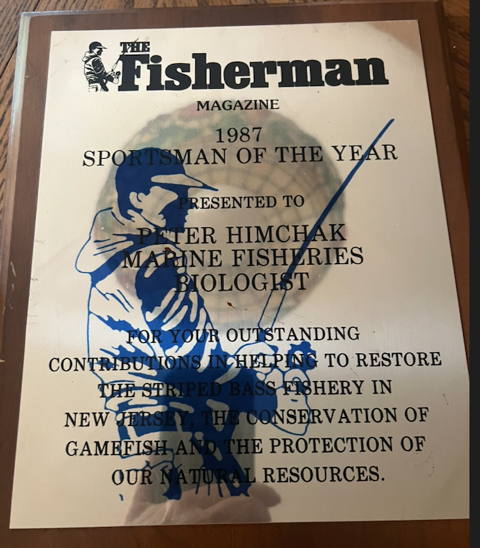
He questioned fisheries scientist Peter Himchak’s objectivity without noting that his own publication had honored Himchak in 1987 with The Fisherman magazine’s Sportsman of the Year award for his work on striped bass restoration and conservation.
The video was published on YouTube and promoted on Facebook, in addition to appearing on TheFisherman.com as part of the magazine’s September 24 report.
We spoke directly with Himchak for his response. He rejected the suggestion that leaving New Jersey’s Division of Fish and Wildlife for industry work changed his scientific standards.
Himchak’s response
“I am first and foremost a scientist,” Himchak said. He described examining data sets, graphs, trends, statistics, correlations, confidence and error bars-the same approach he used in state service. “Science must be objective.”
Himchak also questioned the selective use of affiliation as a credibility test, noting that individuals affiliated with recreational fishing and environmental organizations serve on ASMFC Management Boards and its committees. His objection is that an employer’s identity cannot substitute for examining the evidence.
Asked about the 50 percent hypothetical, Himchak said his position would change if the data justified it. If an assessment showed fishing mortality well above the overfishing threshold, he said, he would give Omega Protein and Ocean Harvesters that news and explain that restrictive measures were needed.
A record of delivering unpopular management news
Himchak noted that he has never feared delivering unpopular recommendations. During the striped bass rebuilding effort, he recalled explaining progressively higher minimum size requirements at New Jersey public information meetings in the 1980s and receiving criticism from fishermen for doing so.
Those measures were part of the broader effort to protect and rebuild the stock. ASMFC identified protection of the 1992 year class as central to the restoration program. As that rebuilding effort progressed, The Fisherman recognized Himchak in 1987 with its Sportsman of the Year award for his “outstanding contributions in helping to restore the striped bass fishery in New Jersey, the conservation of game fish, and the protection of our natural resources.” ASMFC records that the restoration effort ultimately succeeded, declaring Atlantic coastal striped bass stocks fully recovered in 1995.
He said he earned that recognition while remaining objective and facing criticism from fishermen. “My mindset as a scientist has not changed from those years to current times,” he said. “It remains objective, as it should.”
What the Bay Cap record establishes
Draft Addendum II presents alternatives, including the status quo and a 50 percent reduction, alongside coastwide quota linkage, seasonal limits and periodic review. These are management choices under consideration, not an assessment finding that a 50 percent cut to the Chesapeake Bay Cap cut is required.
The Bay Cap was reduced by 20 percent for 2013 and then to 51,000 metric tons for 2018, roughly another 41 percent reduction. The current draft acknowledges insufficient data to comprehensively characterize Bay-wide menhaden abundance, distribution and fishing effects. It contains data, but does not establish a quantified biological requirement for the proposed 50 percent cut.
When the Cap was first imposed in 2006, it was a political compromise between Virginia, Maryland, and environmental groups, not a conservation measure grounded in a scientific justification. As ASMFC’s Executive Director at the time, Vince O’Shea, testified before Congress in 2008, the Bay Cap was established “in response to a political problem” and “there was not a science basis for the Cap.”
That view was echoed by ASMFC’s scientific staff. In 2012, the Menhaden Plan Development Team concluded, “The annual Chesapeake Bay harvest cap is not based on a scientifically quantified harvest threshold, fishery health index, or fishery population level study.”
In a follow-up report that same year, the ASMFC Technical Committee stated: “The TC stands by its previous recommendation that, given the current fishery and history of landings, there has not appeared to be any biological benefit to the Chesapeake Bay Reduction Cap since it was implemented.”
The Technical Committee reinforced this position during the Commission’s December 2012 meeting, with the then-chairperson noting that, “Given the current structure of the industry right now, and the fish that they harvest, and the biological information that we’re collecting, there doesn’t seem to be any benefit” from the Bay Cap.
ASMFC leadership previously said the evidence was not there
This is not a new scientific question. In a July 30, 2026 letter to the Atlantic Menhaden Management Board, Ocean Harvesters reproduced language from then-ASMFC Chairman James J. Gilmore Jr. addressing Virginia’s appeal of the reduction of the Chesapeake Bay Cap from 87,216 metric tons to 51,000 metric tons.
Gilmore wrote: “There is no evidence in Amendment 3 to support the view that lowering the Bay Cap was necessary to protect the Bay as a nursery area for menhaden and there is no evidence to suggest the Bay Cap is necessary to protect the Bay as a nursery for other species. Leadership agrees the Amendment does not provide sufficient evidence to support such claims.”
That statement addressed the specific nursery protection rationale in Amendment 3. It matters now because the current 51,000 metric ton cap already reflects substantial prior reductions, while Draft Addendum II again considers cuts of up to 50 percent and acknowledges that sufficient scientific information is still not available to comprehensively characterize menhaden abundance, distribution and fishing effects throughout Chesapeake Bay. Hutchinson does not grapple with that history when attacking Himchak for saying the scientific case for another 50 percent reduction has not been demonstrated.
Independent analyses undercut the “gauntlet” claim
Hutchinson relayed the claim that Virginia’s reduction fishery is preventing menhaden from reaching fishermen farther up Chesapeake Bay. But the available analyses do not support that simple cause-and-effect story. ASMFC’s own review indicated little reduction fishery influence on Maryland pound net catch rates in 2023; for 2024, it identified only a possible effect and said finer-scale information on fishery dynamics and menhaden movement would be needed.
A January 2026 Georgetown Economic Services analysis (Exhibit B, p. 16) tested the interception theory directly. If Virginia purse seine activity were blocking menhaden from reaching Maryland, Maryland pound net catch rates should fall sharply during the relevant period. Instead, the analysis found that pound net catch rates continued on a relatively steady seasonal increase. It also found that months with Virginia reduction purse seine sets above the 10-year average tended to coincide with Maryland pound net harvest above its 10-year average, while below-average Virginia activity tended to coincide with below-average Maryland harvest.
A separate analysis in Dr. Arnoldo Valle-Levinson’s actual report, Menhaden Catches in Mid-Chesapeake Bay, examined the physical and environmental conditions in the Chesapeake Bay alongside the Maryland fishery data. His analysis found a consistent relationship between Maryland catches and catch rates and changes in hypoxia depth over annual cycles. When low-oxygen water rises and compresses usable habitat, fish can become concentrated in a smaller oxygenated layer, changing their availability and catchability.
A summary of Valle-Levinson’s analysis explains that Maryland catches and fishing trips declined together, while catch per unit effort did not show the sustained collapse that would be expected if the upper Bay were being systematically deprived of menhaden. His analysis points to fishing effort and Bay conditions, including dissolved oxygen, salinity, temperature, habitat compression, plankton and other environmental factors, as important influences on where menhaden occur and how catchable they are. Those findings directly challenge the “gauntlet” narrative Hutchinson repeats.
The data behind Himchak’s position
Himchak cites stable-isotope chemistry research by Kristen Anstead and colleagues, published in Transactions of the American Fisheries Society, which challenges older assumptions about the Chesapeake Bay’s contribution to the coastwide menhaden population. Their 2016 four-region analysis estimated that an average of about 31 percent of age-1 recruits from the 2009-2011 cohorts originated from Chesapeake Bay nurseries, far below the historical, unvalidated estimate of 69 percent. Their 2017 study produced a similar result, estimating that about 30 percent of sampled age-2 to age-4 fish from the 2008-2010 cohorts originated from Chesapeake nurseries. These studies do not measure current Bay abundance, but they do show that the long-used assumption that Chesapeake Bay supplies nearly 70 percent of the coastwide menhaden population was not supported by the sampled cohorts.
Maryland’s long-term juvenile seine survey provides a measure of the relative abundance of young-of-year menhaden in Chesapeake Bay. The Maryland Department of Natural Resources’ 2023 survey reported that menhaden abundance was the highest measured in more than 30 years. The 2025 survey found a third consecutive year of the highest Atlantic menhaden recruitment in the Bay since 1990. These results document several recent years of strong juvenile occurrence, indicating that the Chesapeake Bay continues to serve its function as an important nursery for menhaden.
Stock status, predator needs and striped bass
The 2025 menhaden assessment classified the coastwide stock as not overfished and not experiencing overfishing. Estimated fishing mortality was below the overfishing threshold, although above the lower management target. Ecological reference points already account for predator needs; the American Sportfishing Association and Theodore Roosevelt Conservation Partnership praised their adoption in 2020.
ASMFC’s April 2025 review evaluated 298,232 striped bass across eight data sets. Its body condition analysis indicated the fish “are not starving and would be considered healthy.” Body condition does not, however, measure population recovery or establish a direct relationship with menhaden availability.
The 2024 striped-bass assessment attributed 49 percent of coastwide fishing removals in 2022-2023 to recreational harvest and another 40 percent to recreational release mortality. ASMFC’s menhaden FAQ states that ending menhaden fishing alone would not rebuild striped bass to their biomass target. Local feeding observations and coastwide rebuilding are different questions.
New Jersey bait fishermen are part of the same working coast
New Jersey’s bait fisheries connect commercial harvesters with commercial and recreational customers. New Jersey’s fisheries agency documents menhaden’s bait and chum uses, while the National Oceanic and Atmospheric Administration (NOAA) identifies its role in crab and lobster fisheries. The reduction sector supplies fishmeal, fish oil and other marine ingredients.
Cape May-based Lund’s Fisheries and Omega Protein participate in the U.S. Atlantic menhaden purse-seine fishery, which holds Marine Stewardship Council certification. These sectors serve different markets – bait and marine ingredients – within a shared coastwide management system. Their economic contributions do not depend on casting one group of fishermen against another.
Hutchinson’s account of supportive webinar comments describes the opinion of the recreational fishermen who made them. It does not resolve biological questions.
Sources and Supporting Documents
Atlantic States Marine Fisheries Commission
U.S. House Natural Resources Subcommittee hearing – May 8, 2008 – Official hearing page for the H.R. 3840/H.R. 3841 hearing at which then-ASMFC Executive Director Vince O’Shea testified; the Bay Cap remarks cited in the release were made during oral questioning.
Atlantic Menhaden Amendment 2 – Plan Development Team discussion, p. 63 – States that the annual Chesapeake Bay harvest cap was not based on a scientifically quantified harvest threshold, fishery health index, or fishery population-level study.
Atlantic Menhaden Management Board Proceedings – December 2012, p. 21 – Technical Committee statement that there had not appeared to be a biological benefit to the Chesapeake Bay Reduction Cap under the fishery conditions then in place.
Atlantic Menhaden Management Board Proceedings – December 2012, p. 22 – Jeffrey Brust’s response that, given the industry structure, harvested fish and biological information being collected, there did not seem to be a benefit from the Bay Cap.
Atlantic Menhaden Draft Addendum II – 2026 – Bay Cap history, proposed management alternatives including a 50% reduction, Maryland pound-net analyses, and acknowledged Chesapeake Bay data limitations.
Atlantic Menhaden Management Board Supplemental Materials – Exhibit B, p. 16 – Georgetown Economic Services, “Analysis of Maryland Harvest Sizes and the Number of Virginian Nets Set.”
Atlantic Menhaden Management Board materials – 2018 Gilmore statement – Contains the statement attributed to then-ASMFC Chairman James J. Gilmore Jr. that Amendment 3 did not provide evidence supporting the specified nursery-protection rationale for lowering the Bay Cap.
2025 Atlantic Menhaden Single-Species Stock Assessment Update – Current coastwide stock status and fishing mortality.
ASMFC adoption of ecological reference points for Atlantic menhaden – 2020 – Commission announcement establishing ecosystem-based reference points that account for predator needs.
Chesapeake Bay Precautionary Management Work Group Report – April 2025 – Includes the striped-bass body-condition analysis based on 298,232 fish and the finding that the fish examined “are not starving and would be considered healthy.”
2024 Atlantic Striped Bass Stock Assessment Update – Reports the shares of coastwide fishing removals attributable to recreational harvest and recreational release mortality.
ASMFC – Atlantic Menhaden FAQs – Explains that ending menhaden fishing alone would not rebuild striped bass to the biomass target.
ASMFC – Atlantic Striped Bass species history – Background on striped-bass restoration and the importance of the 1982 year class.
Chesapeake Bay and Maryland analyses
Arnoldo Valle-Levinson – Menhaden Catches in Mid-Chesapeake Bay (original report) – Original analysis of catch, effort, catch-per-unit-effort, hypoxia depth, habitat compression and other environmental influences.
Public summary of the Georgetown and Valle-Levinson analyses – Summary discussing both analyses and their implications for the interception or “gauntlet” theory.
Maryland DNR – 2024 Young-of-Year Survey results – Reports 2024 juvenile menhaden abundance nearly equal to 2023, when the index was the highest measured since 1990.
Maryland DNR – 2025 Young-of-Year Survey results – Reports menhaden as widespread for the third consecutive year.
Peer-reviewed menhaden research
Anstead et al. – 2016, Transactions of the American Fisheries Society – Otolith-chemistry analysis estimating Chesapeake Bay contribution to sampled age-1 Atlantic menhaden cohorts and comparing it with the historical 69% estimate.
Anstead et al. – 2017, Transactions of the American Fisheries Society – Follow-up analysis of nursery contributions to older menhaden cohorts.
New Jersey, fishery uses and sustainability
New Jersey Division of Fish and Wildlife – Atlantic menhaden bait-fish information – Documents menhaden’s use as bait and chum.
NOAA Fisheries – Atlantic Menhaden – Background on Atlantic menhaden and its use as bait in commercial fisheries including crab and lobster fisheries.
Marine Stewardship Council – U.S. Atlantic Menhaden Purse Seine Fishery: client listing – Identifies client-group participants including Lund’s Fisheries and Omega Protein.
Marine Stewardship Council – U.S. Atlantic Menhaden Purse Seine Fishery – Current certification record for the fishery.
Theodore Roosevelt Conservation Partnership – 2020 statement on ecological reference points – Recreational/conservation response praising ASMFC’s adoption of ecological reference points.
About the American Small Pelagics Network
The American Small Pelagics Network represents fishermen, processors, suppliers, and coastal communities connected to fisheries such as menhaden, mackerel, herring, squid, and butterfish. ASPN advocates for sustainable fisheries management that supports critical fish species, while maintaining economic opportunities for fishermen and fishing communities.
PRESS CONTACT
Stove Boat Communications
202-595-1212
contact@smallpelagics.com
SOURCE: American Small Pelagics Network
View the original press release on ACCESS Newswire
Media gallery